Supporting the Supporters: Help Exhausted Carers
Caregivers do a wonderful job, so check you get benefits for you and patients which can open the way to grants for comfortable wheelchairs and home adaptations. Also look up local volunteer groups who offer respite care and sometimes volunteer dog walkers.
- Dog-walking charity The Cinnamon Trust lists pet-friendly care homes.
- Age UK can help with financial grants to handyman jobs. Recare can help to afford disabilitiy equipment.
- Skiggle is an online community to donate surplus or exchange disability equipment, with safety caveats (you must not make profit from NHS items). Examples are catheters, ventilator filters/adaptors and mobility aids.
Sustainable tableware for carers and patients
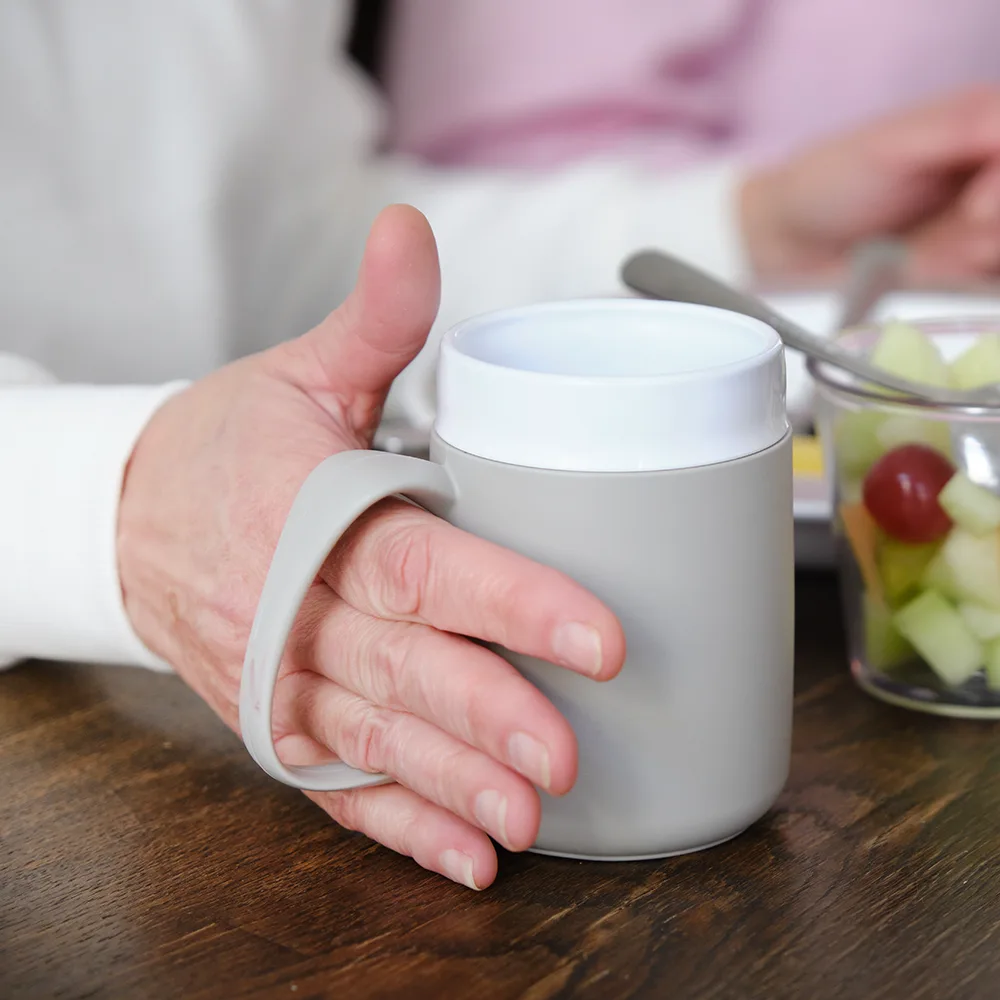
- Ornamin (Germany) offers sustainable keep-warm plates, ‘dementia-friendly’ crockery in bright colours to stimulate appetite, circular spoons for easy eating, and mugs for people to drink without having to lean their heads back.
- Eat Well offers cups with rubber bases (and trays to clip on aprons, to catch dropped food and prevent clothing stains).
- Easi-Grip knives have stainless steel blades and bright ‘soft feel’ grip. The angled handles prevent wrist discomfort, and knives are less likely to twist.
- Droplet (on NHS) is a mug that monitors fluid levels and records personal messages, to remind patients to drink.
Read up on food safety for people and pets (many foods are unsafe near animal friends). Before recycling tins, rinse/remove lids (or pop ring-pulls over holes) then step on the can to ‘pinch’ inner rims together, to stop wildlife getting trapped.
Although it’s good to compost food scraps, unless you have a food waste bin (turned into biogas), just bin allium scraps (onion, leeks, garlic, shallot, chives), citrus/tomato/rhubarb scraps and tea/coffee grounds. To avoid too much acid/caffeine affecting compost creatures.
Free textured veggie meal plans

Vegetarian for Life is a charity that serves vegans/vegetarians in care homes, hospitals or independent living facilities. Its means planners include recipes for:
The meal planers include recipes for:
- Baked potato, baked beans, date & orange salad, fresh fruit
- Lentil & spinach quiche, chips, mixed salad, stewed apple & raisins
- Tomato & basil soup, vegan lemon meringue pie
- Veggie roast, potatoes, jam sponge & custard
- Cottage pie, cabbage, yoghurt & mixed berries
- Chickpea croquettes, chips, salad, rice pudding
- Macaroni soup, bread, banana split
- Vegan ham & salad sandwiches, Victoria sponge
- Pasta bolognese, sweetcorn & beetroot salad, ginger cake
- Cauliflower cheeze, baked potato, peas, apricot blueberry crumble
- Vegan cheese & tomato sandwich, cherry cake
You can also download a free catering guide and a guide to textured foods, for vegans and vegetarians who are no longer able to eat solid food. Also find grants to help vegans live independently.
Switch donations to humane research
Most medical charities receive millions of pounds/dollars, to carry out unkind, out-dated and ineffective experiments on innocent animals.
Instead, switch donations to humane research charities which fund boffins at universities doing wonderful work without animals, yet receive fewer funds and no government help. And more chance of a cure.
Financial help for carers and patients
- Disabled Facilities Grants (UK) can be used to widen doors, install ramps and grab rails, build downstairs bathrooms and heating/lighting controls.
- Family Fund offers grants for children with disabilities.
- NHS has info on how to apply for walking sticks and NHS wheelchairs. You can apply for a personal wheelchair budget to upgrade to a more comfortable one. Which? has a good post on how to choose the best wheelchair.
- Remap has volunteer ‘garage tinkerers’: a garden chair for an amputee, an oven door opener for weak hands, a one-handed sandwich cutter for a stroke survivor, and emergency brake for an epileptic.
- You can claim for compensation if you were made disabled (or have mental health issues) while serving in the Armed Forces.
Ben Ryan created a fantastic bionic limb for his young son, who had to have a limb amputated at birth, due to a blood clot. He quit his job to set up Ambionics.
Yet despite winning an inventor’s prize, the government won’t fund him. Yet his genius could change the lives of children – yet MPs spend money on bombs.
Free help for home telephones
- Relay is a free app to help people who have difficulty using the telephone. Also register with BT Protected Services Scheme (this prevents your bill being cut off, in case you forget to pay).
- BT Home Essentials offers cheaper calls/broadband (apply for BT Priority Repair & free BT directory enquiries).
- If you’re registered blind, Royal Mail offers free postage (national and international) of books, media & mobility aids. Also get free loan of digital radios and touch-to-see books.
Free mobility help
- People in wheelchairs can get free equipment like raised toilet seats, bath rails, slip mats etc.
- Order a radar key (to access disabled toilets) and blue badge (parking).
- Londoners with a disability can get discounted (limited) travel across the city via Taxicard. Apply to your borough (GPs can endorse applications).
- The Disabled Person’s Railcard is available for many people on benefits (and epilepsy). It costs £20 for 1 year and entitles a third savings on all fares.
Read rules for train travel with pets. Animals must be kept on leads or in carriers, and aside from guide dogs (who still may find them stressful), pets are not allowed on seats/escalators (must be carried).
Help for people with specific diseases
Parkinson’s disease patients should avoid choking hazard foods like roast potatoes, nuts and seeds. Ask an occupational therapist to adapt homes to make them fall-proof and use non-slip mats/rugs and remove clutter, trailing wires and frayed carpets. Also wear supportive shoes (not clogs).
It’s thought that just 10 to 15% of PD cases are genetic, the others due to head trauma or garden pesticides (one banned in the UK is still exported to the US). So grow no-dig organic food (read up on pet-friendly gardens).
- Pathfinder uses a laser to attach to shoes to provide a visual obstacle to prevent falling. Wear with hard flat shoes. LaserCane beams a laser in your path, and U-Step is a safer zimmer frame, that won’t roll away.
- SteadyScrib is a pen that uses magnetic technology to address tremors, rigidity and bradykinesia (slow movement). So writing goes back to normal.
- Gyenno Spoon keeps hands steady while eating, like ‘sticking your hand in thick syrup’. It was invented by a medical student, who watched a patient struggle to eat a bowl of soup.
- StairSteady is more affordable than stairlifts, which locks handrails in place, then folds away when not in use.
- Beech Band is currently crowdfunding to sell at an affordable price, a tapping device to help clear speech.
- Kangaroo Cup stops trembling hands, the new versions are ceramic.
Multiple sclerosis is sometimes due to genetics, and also linked to lack of vitamin D (sunlight), amalgam fillings and high consumption of cow’s milk (all due to reduced immunity- MS is more common in countries that drink a lot of dairy).
Regular exercises keeps limbs flexible, betters balance and increases muscle tone, for less chance of injury (exercise also helps with depression). Trained fitness coach Joe Wicks offers a 10-minute chair fitness work.
Dementia is often due to clogged arteries in the brain (so prevention is just like heart-disease with a low-fat plant-based diet). There is no hard evidence yet that aluminium causes dementia, though you may wish to choose nontoxic saucepans (there’s more aluminium in tap water and polluted air).
- Keep to a Routine. Dementia patients love routine. Get up and go to the bed at the same time, same with meals.
- Make the space safe. Keep cleaning products to alchol in locked cupboards, and remove tripping hazards.
- Dementia UK is a non-animal testing charity with a free helpline and free Admiral nurses, who provide specialist care.
Sustainable help for bladder health

Raspberries (Real & Vibrant) and pears are good for bladder health.
- More free public toilets help, as often older people don’t go out or restrict liquids, as they are worried about not finding somewhere to spend a penny).
- If you pop to the loo a lot, switch to forest-friendly bathroom tissue (to save trees!) These brands are just as comfy, sold in plastic-free packaging.
- Carrying extra pounds puts more pressure on your bladder!
- Drink two glasses of water before each meal, and avoid caffeine and alcohol, that irritate the bladder. Make a few tweaks for less leaks!
- Tone up your pelvic floor muscles. Tighten as if you are about to pee, hold for a slow count of five (don’t hold your breath). Release, reset for five seconds, and repeat 10 times. Do this three times a day.
Sustainable helpers for incontinence
- Organic feminine care pads can be used for light incontinence. TOTM liners are made with organic cotton and wrapped in compostable film.
- Uribag (free on the NHS, ask your GP) is a portable latex canister (empty your pee on the kerb, then wash at home). The female version is bedbound patients.
Sustainable supplements for urinary health

Feel V-Health is sold in zero waste packs, it’s also vegan and not tested on animals. Designed to help people with urinaty tract infections, it uses D-Mannose, Uva Ursi, Cranberry extract, evidence-based botanicals and two V-health targeted live-bacterial cultures.
Check with GP before taking supplements if on medication (or if pregnant/nursing). Keep supplements away from children and pets and recycle unused ones at pharmacies (never flush down the loo).
- 1 month (D-Mannose and cranberry extract should be fighting E.coli bacteria in the urinary tract wall, and vitamin C should have increased for better immunity)
- 3 months (less urinary tract infections and better feminine health)
- 1 year (stronger immunity and less UTIs)
Dr.Vegan PH Hero is sold in a refillable metal tin, with eco-friendly pouches for refills. It contains 12 billion CFU live cultures, along with sea buckthorn, nettle and cranberry.
- In 2 weeks (less itchiness and urgency to urinate)
- In 1 month (less dryness and discharge)
- In 2 months (fewer signs of burning, itching or infections)