Love in Action: Help Animals in War Zones
As if war is not bad enough, most of us look on in horror as innocent animals are also bombed, or have their human guardians, homes or habitats blown to pieces, set on fire or suffer from the consequences left over (from starvation to lack of fresh water and food, to no heating in winter climates).
Of course this all means humans suffer too. But animals are often more innocent forgotten victims, from pets to native wildlife, and from caged zoo animals to working donkeys and farm animals. Many end up hungry, scared, injured or facing a fight for survival, whether due to disasters around them, or losing their human guardians to killing. Here are some simple ways to help.
If you wish to donate anonymously to below charities, set up an account at Charities Aid Foundation. Make one-off donations or set up giving accounts (for business, Gift Aid is taken care of).
You can also nominate NowZad and WarPaws (and Safe Haven for Donkeys) at My Giving Circle. This means that instead of donating on the individual charity websites, your donations are pooled with others.
Whichever charity gets the most support periodically gets a windfall donation from the website founders, to fill up the coffers with much-needed funds.
Nowzad (helps animals in Afghanistan & Ukraine)
Nowzad does amazing work for animals caught up in conflict abroad. They are need of financial help, as funds have gone down substantially recently due to the cost of living.
The charity was founded by a former Royal Marine Sergeant serving in Afghanistan, who was appalled to see how many animals were suffering. He rescued and befriended a dog involved in organised dog-fighting and named him ‘Nowzad’ – his first ever name.
Originally formed to rescue stray cats and dogs in the country, today it has a bigger mission of helping animals worldwide. Volunteers in Afghanistan educate people on how to care for donkeys and horses (the main form of transport) and provide vet care.
It’s also recently opened the country’s first sanctuary for older and retired/ill equines. Here they receive loving care, good food and veterinary care, on the outskirts of Kabul. Donations fund:
- £1 – a kilo of bran
- £8 – a monthly hoof trim!
- £20 – an insulated winter coat
- £30 – a month’s fuel supply for the sanctuary
- £50 – a month’s water supply
- £80 – a month’s hay supply (tasty if you’re an equine!)
The charity also has a sanctuary for dogs and cats in Afghanistan, where local people can find free advice and vet care. Plus vaccinations and spaying/neutering services (important to prevent over-population, which often leads to pets living on the streets).
The veterinary team also humanely capture and peacefully put to sleep any local dogs with rabies (presently no cure) so they are not killed by others, in less humane ways.
Nowzad is also working closely with heroic volunteers at animal shelters in Ukraine, which have obviously seen a huge uptake in residents, since the invasion a few years ago.
Help to Save the Afghanistan Shelter
Recently (due to road construction and building high-rise buildings in Kabul) some sanctuaries are to be bulldozed, so the charity urgently needs funds to rent new land and build a stable sanctuary in a safe place. Plus it needs to safely move each resident (this will cost around £100K).
Easy ways to Support Nowzad Charity
- Make it your page at easyfundraising. Then any time you buy something at participating retailers, the charity gets a cut, at no cost to you. Does not affect loyalty points.
- Leave a legacy in your Will, to help animals after you’ve gone.
- Donate your scrap car (including the USA).
- For special occasions, save a tree and send an e-card to help.
- Bideford (Devon) has a retail charity shop, to raise funds.
- The Nowzad trolley coin fits supermarket trolleys, to save you fiddling around for a £1 coin.
War Paws (helping forgotten victims of war)
War Paws also provides resources and rescue for animals in war zones. It tries to remove animals caught up in conflict, but also educate local populations on animal welfare.
Mostly working with dogs and cats, it works mostly in Syria and Afghanistan. And also supports serving soldiers and contractors in war zones and areas of civil conflict, by reuniting them in home countries, with dogs and cats they bonded with, on tours of duties.
It also helps to humanely reduce stray dog populations through trap-neuter-release programs, and provides medicine to help prevent rabies.
Easy Ways to Support War Paws
- Make it your page at easyfundraising. Then any time you buy something at participating retailers, the charity gets a cut, at no cost to you (loyalty points are not affected).
- Recycle used ink cartridges, old jewellery (even broken) and used stamps.
- Donate by sending an e-card instead of a tree card.
Safe Haven for Donkeys (in the MIddle East)
Safe Haven for Donkeys helps donkeys living on the border in the Middle East, of extreme concern at present. Donkeys and horses are the main form of transport for many, and often worked on little food or rest. Read more on helping donkey friends.
This charity has just set up a project in Egypt to help donkeys who work in intense heat to move bricks to kilns (used to build houses). Many have untreated wounds, fly infestations and overgrown hooves. The animals are treated on-site and at mobile clinics.
Easy Ways to Help Safe Haven for Donkeys
- Make it your page at easyfundraising. Then any time you buy something at participating retailers, the charity gets a cut, at no cost to you (loyalty points are not affected).
- Playing their Weather Lottery (instead of the national one) is good to earn them extra funds.
- scrap your old car, and monies raised from metal will benefit this wonderful cause.
- Lucy’s UK Donkey Foundation also gives grants, to help working animals in the Holy Land. Again, make it your page at easyfundraising.
How to Help Animals in Ukraine
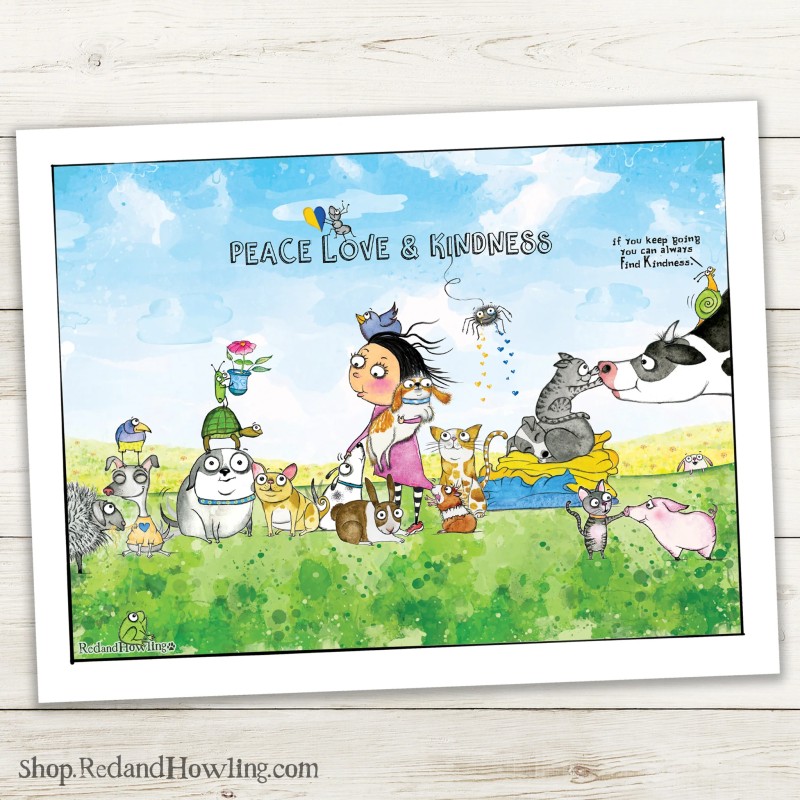
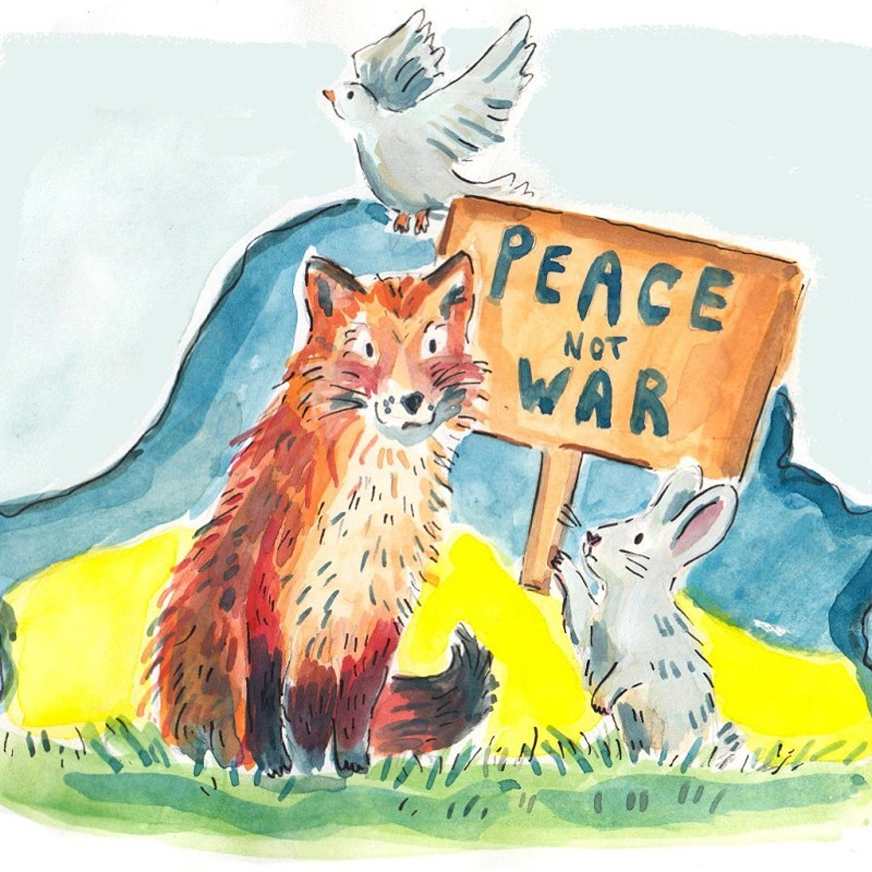
The war in Ukraine has also affected many animals, not just humans. 25% of profits from this print by Red and Howling are donated to animal rescue causes worldwide.
Good Good Good is an American newspaper with a super post on how we can help (the end of the post includes animal shelters to help).
Four Paws and IFAW are both major charities that have international relief teams, that kick into action for both wars and natural disasters, when animals need help.
How to CreateWorld Peace!
World peace. We all want it. And it’s heart-breaking that in the 21st century, we still have politicians who believe killing each other, is the way to create it. Or that the way to make money is to sell weapons that kill innocent people.
One of the best ways we can help to create world peace is to not buy into the bias and not-very-effective media, which rarely reports the full story, and does not hold war-starters to account. Get real facts at Byline Times (no ads or bias).
Why after Hitler – are media journalists still standing around watching people in grand rooms shake hands and pose for cameras, when they have so much blood on their hands?
Where are the proper journalists doing their jobs? One yell from Trump that it’s ‘fake news’, and everyone just goes silent.
Why Do the Same Countries Go to War?
If you look at those who research the answer, it’s quite interesting as the answers are pretty simple. It’s nearly always countries with oil (UK, USA, Russia, Middle East).
Often the countries have biased media (Fox News) or state media (Russia, Iran). Our own news gives soundbites – do you know why Russia invaded Ukraine or why the Middle East is always at war? Not many of us really do.
Remember the Girl Burned by Napalm?
We’ve all seen the infamous photo of Phan Thị Kim Phúc (who ran from the scene in Vietnam after being burned from a napalm attack). She spent 14 months in hospital and her brother (to her left in the photo) lost an eye).
Nick Ut (who had just watched a baby die in its grandmother’s arms) put down his camera after taking the photographer and took her to hospital. He remained friends with both siblings, she now runs The KIM Foundation, to help other child victims of war.
Is There a Solution to the Israel/Gaza War?
You would think not, but actually this war (which dates back 2000 years and got worse after a war in 1967 which left Israel with the West Bank and Gaza Strip) has seen conflict grow.
But instead of western politicians sorting things out, why don’t they listen to experts who may have one? Political writer Daniel Levin (whose father had his arm blown off in the last days of the 1948 war) says a different vision of a two-state solution could work.
It would retain aspects of one-state (freedom of employment, movement and residency with security controls). So people could live, work and study anywhere. But only vote in their own state.
Israelis living in occupied Palestine could move back if wished to Israel (with relocation papers) or remain in Palestine and follow their laws. Visit A Land for All for more information.
Seeds of Peace is a US summer camp, where they take opposing sides to have them work and play together, to become the future leaders of tomorrow (say Israeli and Palestinian teenagers). They arrive wanting to kill each other, and leave as friends.
Finding Hope in the Midst of War
The Forgiveness Project is a website set up by an Italian journalist, which interviews those who have chosen to forgive. This is big stuff: mothers who have forgiven those who have murdered their sons, adults who have forgiven parents for years of abuse and sons who have forgiven terrorist fathers.
But also it focuses on those who forgiven others in war. Recently, the founder interviewed two fathers (one from Palestine and one from Israel) who both had young daughters murdered (by an Israeli solider and two Palestinian suicide bombers respectively).
But rather continue the cycle of violence, both now work for peace organisations, to prevent such things happening again.
Treating Women Well Creates World Peace
Most countries that go to war, have issues with women. Most men are peaceful, but it’s true that (aside from Margaret Thatcher), most countries that don’t go to war are led by women (until recently that would be New Zealand, and many Scandinavian countries).
It’s not that men are more ‘violent’, but that sometimes the egos come out (think Johnson, Trump and Putin).
Malala Yousafzai was born to a Pakistani education activist (and humanitarian father). The world’s youngest Nobel Prize laureate was shot in the head (along with two friends who recovered) for writing a blog on what life was like, living under the Taliban.
She graduated from Oxford University with a degree in philosophy, politics and economics and now campaigns for world peace and education for girls.
No Guns, No Wars: Exploring Weapon-Free Nations
It’s a colossal amount of money that England spends on the Armed Forces, Royal Navy, Royal Air Force and Trident (our nuclear deterrent). There are always arguments on why we need nuclear weapons etc. But what’s helpful is to look at countries that don’t have any armies. What makes us need them, when other places don’t?
Some countries worldwide have either never had or got rid of their armies, instead investing money in nature, education, people, healthcare and peaceful relations with other countries.
Costa Rica’s Bold Move to Peace
In 1948, Costa Rica came out of a short but bitter civil war. José Figueres Ferrer won power and abolished the army the same year, to keep the state focused on peace.
Money once earmarked for soldiers, helped to build classrooms and health clinics, which led to fast gains in life expectancy and literacy.
The country is now no.1 on the World Happiness Index with protected rainforests and a huge income from ecotourism.
This is an exemplary little country. We are the example for Latin America. In the next century, maybe everyone will be like us. José Figueres Ferrer
José sounds an interesting character. He served three terms as president, and during the first term, also brought banking back to national ownership, granted women and Afro-Costa Ricans the right to vote, and also offered Costa Rican nationality to people of African descent.
After becoming a successful coffee farmer and rope maker, he described himself as a ‘farmer socialist’. He built housing and provided medical care for his workers, and established a community vegetable farm to provide free food.
And if his workers could get better prices, he let them!
He sounds a bit like our George Cadbury, the successful Quaker businessman who built his workers the pretty village of Bourneville, near Birmingham. George was a strict teetotaller, and created drinking chocolate, to stop his workers drinking gin!
José’s son also went into politics and became President for a while, and now focuses on helping organisation to create a low-carbon economy, to save the planet and wildlife.
Iceland’s Path of Neutral Strength
Iceland became a republic in 1944 after centuries linked to Denmark. With a low population and a harsh surrounding sea, it needed no standing army. The The Icelandic Coast Guard and police handle protection at home.
This means money that would be used for armies, has instead been invested into geothermal energy that heats and lights homes and powers industry. It’s quite a well-off nation with one of the world’s best standards of living.
Andorra’s Timeless Neutrality
High in the Pyrenees, Andorra is one of the world’s smallest countries, sitting between France and Spain. It’s a principality (like Monaco, run by a king) but still quite diplomatic, which has kept the country out of wars for decades.
Its border of steep mountains also helps to keep it safe. It also is one of the few countries on earth, with no airport.
Unlike in England with our public spats, Andorra is ruled by two princes who get on well. But neither are local, and neither are real princes! One is the Bishop of Urgell and the other is the President of France!
It’s a bit bonkers, as this means that one of their rulers is elected by voters in another country! And the other elected by the Pope in Rome! Having said that, many people think it odd that we are ruled over by a family that was never elected either!
Andorra also had a self-proclaimed ‘world king!’
Just like our previous Prime Minister Boris Johnson who proclaimed he would like to be ‘world king’ (and did not respect responsibilities that came with the job), Andorra had Boris I (King of Andorra), who was actually Russian swindler Boris Skyossyreff. Who in 1934 declared war on the Bishop of Urgell (one of Andorra’s co-princes).
However, the Bishop arrested him and threw him out of the country! He ended up serving 25 years in a Siberian camp, before being released and dying in his 90s.
Lessons to Learn from Army‑Free Nations
Reinvesting earmarked defence funds would free up cash for the NHS, education and measures to reduce climate change (like free insulation of all older homes, which would also create thousands of skilled jobs).
We could protect our forests, build affordable homes (on wasteland, not green land home to native wildlife).
We could invest in measures to prevent floods, create state-funded help for pets and wildlife, save our endangered species, fund litter clean-ups, build walkable communities and cycle paths that linked towns, save independent shops, clear the national debt and keep communities safe.
Instead, all this money goes to fund big white elephants like Trident, because people still seem to think we are an empire that needs to get involved in wars all the time.
Nuclear systems come with waste and accident risks that last for generations. Instead, we could be like Costa Rica, and invest in people instead.
How Much is UK Defence Spending?
In 2025, the UK defence budget was projected to be almost £60 billion, almost 3% of GDP. Of course we need to keep safe, but usually selling arms to dodgy regimes and keeping Trident means we spend a colossal amount of funds that could be directed elsewhere. Why does the UK need Trident, but Austria and New Zealand (both 100% nuclear-free) don’t?
Running Trident costs around £3 billion a year, and replacing it will cost at least £205 billion, according to calculations by CND. This money by contrast could be pay for:
- Building new hospitals and funding more nurses. It costs around £100 billion to pay for 180 state-of-the-art hospitals or 1.5 million affordable homes (not on wildlife-rich land).
- Reducing NHS backlogs, by funding more doctors
- Building sustainable affordable homes and ending homelessness
- Building new schools and increasing teacher salaries
- Training young people in new skills
- Investing in better cleaner energy
The jobs lost by reducing the size of the Army and Navy could be go into new skills for renewable energy, insulating homes and other well-paid jobs to reduce bills for people nationwide, and help to stop climate change. Many also have skills to reduce terrorism and cyber-hacking.